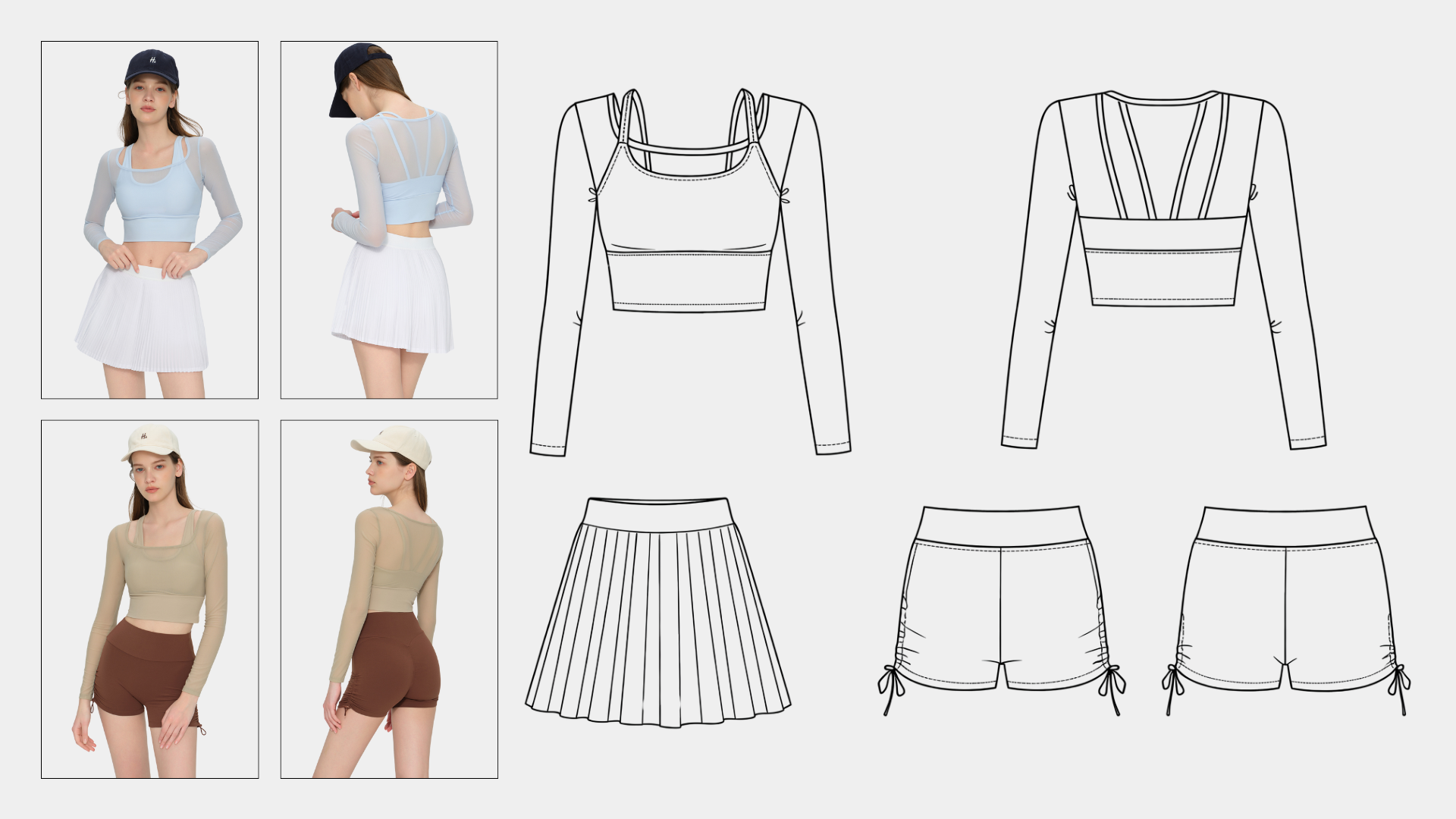
Style Flat Illustration Featuring JLA09537 Long Sleeve Top, JLA09357 Pleated Skirt, and DJI108853 Drawstring Shorts
You've got a killer product idea. You've sketched designs on napkins, shared mockups with friends, and you're ready to take the leap into manufacturing. Then someone drops the phrase "tech pack" and suddenly you're drowning in YouTube tutorials about spec sheets, grading systems, and tolerance ranges.
Your stomach drops. Do I really need all of this before I can even talk to a manufacturer?
The short answer: probably not. And if you're a solo founder or early-stage brand, the long answer might surprise you even more.
What a Tech Pack Actually Is (And What You're Afraid Of)
Let's demystify this first.
A tech pack is essentially a detailed instruction manual for manufacturers. It typically includes flat sketches of your garment from multiple angles, detailed measurements (graded across sizes), fabric specifications, color codes, trims, construction notes, and labeling requirements. For brands producing custom designs or working with high-touch ODM (Original Design Manufacturer) partners, a comprehensive tech pack is genuinely valuable—it's the blueprint that prevents a thousand production mishaps.
But here's the thing: a tech pack can range from a simple 2-3 page document with photos and measurements to a 20+ page architectural masterpiece complete with CAD drawings and tolerance charts. Most first-time founders picture the latter and panic. They're imagining themselves hiring design agencies, buying design software, creating perfect graded specs for every size from XXS to 5XL.
That's not your reality. Not yet, anyway.
The Myth That's Costing You Time (And Money)
The biggest barrier to entry right now isn't technical—it's psychological.
The myth: "I need a perfect, detailed tech pack before I'm even allowed to call a manufacturer."
The reality: Most manufacturers, especially those working with emerging brands, can work with much less. In fact, some of the fastest-growing apparel brands we know launched with nothing more than product photos, a size chart, and a reference sample.
Here's what this myth costs you:
3-6 months of procrastination while you obsess over getting specifications "right"
$2,000-$5,000 hiring a designer or design agency to create professional tech packs
Endless iteration cycles because you're designing in isolation instead of getting manufacturer feedback
Missed market windows because you're perfectioning instead of shipping
The paralysis of choice, where you're so afraid of making the wrong call that you make no call at all
The cruelest part? Most of that work is wasted. Manufacturers will ask for changes anyway. They'll suggest different fabrics. They'll tell you a seam placement won't work. They'll recommend a supplier for your trims that has a 12-week lead time. Your "perfect" tech pack becomes version 0.5, and you should have started there from the beginning.
When Tech Packs Matter (And When They're Overkill)
The reason this confusion exists is that tech packs actually do matter—in specific contexts. You just need to know which one you're in.
Custom ODM (Original Design Manufacturer)
If you're asking a manufacturer to create something from scratch—a proprietary blend of fabrics, a unique construction technique, a one-of-a-kind silhouette—you need detailed specifications. This is high-touch partnership. The manufacturer needs to understand exactly what you're envisioning because they're building something that doesn't already exist in their factory.
In this scenario, invest the time in a solid tech pack. Hire a designer if needed. Get the specifications right. This is where $3,000 spent on clear documentation saves you $30,000 in production mistakes.
Ready-to-Launch OEM (Original Equipment Manufacturer)
If you're working with OEM partners who already make similar garments—companies that produce thousands of t-shirts, hoodies, and basics monthly—you're in a completely different game. They have standard patterns. They have proven construction methods. They have established supplier relationships for common fabrics.
In this scenario, your "tech pack" might be nothing more than:
Product photos or a reference sample
Your exact measurements (usually just your most popular sizes)
Fabric and color preferences
Any custom branding or labeling requirements
The manufacturer already knows how to make a quality t-shirt. They don't need a 15-page specification guide. They need to know what your version of a t-shirt looks like.
Most early-stage brands are in the OEM category. And most of them are wasting months on unnecessary documentation.
How to Brief a Manufacturer With Minimal (But Effective) Documentation
So if a full tech pack is overkill, what do you actually need?
Here's the "good enough" documentation that gets manufacturers excited to work with you—and gets samples rolling in weeks instead of months:
1. Reference Sample or Detailed Product Photos
Send what you're actually trying to make. A real sample (even a rough prototype you made yourself) is worth more than a 50-page spec sheet. If you don't have a physical sample, high-quality photos from multiple angles—front, back, side, close-ups of seams and details—work surprisingly well.
2. Basic Measurements (Simplified Grading)
You don't need perfect grading for every size immediately. Start with measurements for 2-3 key sizes: Small, Medium, Large. Provide the chest width, length, sleeve length, and any other critical dimensions. Most manufacturers have standard grading increments they use anyway. You'll refine this during sampling.
3. Fabric and Color Specification
Be specific about what you want, but not prescriptive about how to get it. Instead of saying "80/20 cotton-poly blend, ring-spun, 6.5 oz weight, vat-dyed navy," try: "soft, structured cotton-dominant blend, heavy-weight, dark navy." Then ask the manufacturer for fabric options. They know their supply chain better than you do.
4. Trims and Special Requirements
Buttons, zippers, labels, tags—note what you need. If you have a preferred supplier or style, mention it. If you're flexible, say so.
5. Labeling and Branding
Care instructions, size labels, brand tags—this matters. Make it clear.
That's it. That's the documentation most early-stage brands actually need to get started.
The Hidden Cost of Over-Engineering
You might think, "But shouldn't I be thorough? Isn't detailed documentation worth the extra investment?"
Sometimes. But consider the actual cost-benefit for a first-time manufacturer:
What you gain from a perfect tech pack:
Slightly faster first sample (maybe 1-2 weeks faster)
Fewer revisions on the second or third sample (maybe 1-2 fewer rounds)
What you lose:
8-12 weeks of your own time
$2,000-$5,000 in design or consulting fees
The ability to get real manufacturer feedback early in the process
Months of delay while you procrastinate on perfection
The risk of designing something that's difficult or expensive to produce
For most founders, the math doesn't work. You're trading months and thousands of dollars to save weeks and hundreds. Backward deal.
The real opportunity cost? Every month you delay is a month your competitors are gaining on you. It's a month you're not getting customer feedback. It's a month you're not building your audience or optimizing your supply chain.
How Ready-to-Launch Collections Eliminate Tech Pack Risk Entirely
There's another option entirely: ready-to-launch collections.
Some manufacturers (the good ones) have already designed and tested garments. They've created the tech packs. They've optimized the patterns. They've vetted the suppliers. They're offering you finished designs that are production-ready, waiting for your branding.
Instead of spending months creating a tech pack for a custom tee, you pick from 5 proven silhouettes, choose your fabric, add your label, and go to production. The manufacturer handles all the specifications. You handle the vision.
For founders in the consideration phase—you're not sure if custom manufacturing is worth the investment yet—this is the golden path. You get to market faster. You validate your concept with real customers. Then, once you have proof of demand, you invest in truly custom designs and detailed tech packs.
It's the anti-perfectionism playbook, and it works.
The Real Question Isn't About Documentation
At the end of the day, the question "Do I need a tech pack?" is asking the wrong thing.
The real question is: What's the fastest path from idea to customer feedback?
For most solo founders, the answer isn't "perfect the documentation." It's "get something in front of customers as quickly as possible, learn what actually works, and optimize from there."
Tech packs matter when you're optimizing for precision. They matter less when you're optimizing for speed and market validation.
Your job isn't to be a technical designer. Your job is to understand your customer and build a brand they want to buy from. If a detailed tech pack is delaying that mission, it's not serving you. It's serving your perfectionism.
The manufacturers that understand this—that get excited about working with hungry first-time founders instead of gatekeeping behind documentation requirements—are your partners. Work with them.
You don't need to have everything figured out. You don't need a 20-page specification sheet. You don't need to hire a design consultant or spend three months perfecting grading tables.
You need to know what you're making and be ready to make it.
It's the difference between launching in couple of weeks and launching in 8 months. Choose wisely.